Solutions.
Built the WebEdify way.
From an internal tool to a customer-facing product, the same declarative foundation scales — inside a dedicated environment that stays yours the whole way. These are the patterns running in production today.
Healthcare Provider Dashboards
Provider performance, RVU tracking, patient volume, comparative analytics. Complex data joins, role-based views, real-time updates — all driven by markdown commands and INode models. No React. No rebuilds when requirements change.
Running today: MedHelp uses this pattern in production for provider dashboards, appointment and diagnosis reporting, and a filter console that drives an entire widget grid.
Key WebEdify wins: Models with segment isolation, <@table> + relay for rich grids, zero-dependency charts, and an AI layer that renders a user's data without ever receiving it.
Enterprise .NET Portals
30+ years of mission-critical systems experience turned into reusable patterns. Audit trails, complex workflows, and integration with the .NET services you already run — without ever leaving the declarative model until you truly need to.
Running today: PAG runs benefits administration on WebEdify, including invoicing and data migration workflows against existing systems.
Moving onto the platform: ACGI, a retirement TPA whose common remitter platform MACRIM built — reconciliation-heavy work that punishes a rigid data model.
Key WebEdify wins: Full .NET extensibility (IProcessor / ITag when required), Cosmos + SQL first-class, Git-native everything.
Multi-Tenant SaaS Products
For the company whose own customers are the tenants — a software product, a membership platform, a TPA serving many employers. You are not subscribing to our multi-tenancy; you are building yours, and you are not designing it. Tenancy is a default database construct here.
Not a new mechanism: segment:catalog is the default primary key format, so the tenant is half the composite key on a SQL table and the partition key path on a Cosmos container.
Key WebEdify wins: Per-tenant connection strings and settings, so one tenant shares a database and another sits in its own. Your product runs in a dedicated environment; your tenants live inside it.
How tenancy worksInternal Tools & Rapid MVPs
The classic “I need this tomorrow” tool that turns into a critical system. Forms, approvals, reporting, file uploads — delivered in hours, maintained for years because the code is readable markdown + HTML, not a black-box low-code platform.
Why it matters later: the tool that was supposed to be temporary is usually the one that ends up in the middle of a real process. This one stays readable and extensible when that happens.
Key WebEdify wins: Velocity without the trade. Drop to C# only when the declarative model genuinely cannot express something — same project, real tooling.
See how an engagement runsContent + Data Hybrid Sites
Marketing sites, resource hubs and documentation portals that also need real data — leads, downloads, personalized views. The content management system is already in the platform, with articles, a media library, taxonomy and draft-and-publish, so this is configuration and design rather than a build.
In the same stack: the 8 Design Strategies, authenticated sections, dynamic lists and forms — so the public site and the members-only part of it are one application.
Key WebEdify wins: The same engine powers your internal tools and your public site, and the CMS sits in the same application as your data. One team, one architecture.
Explore the 8 StrategiesNonprofits, Churches & Member Organizations
Organizations here usually run a CRM, a donation processor, a CMS and a spreadsheet, then pay for a reporting layer on top of all four. Here the donation, the receipt, the member record and the public site are one system.
For churches: your ChMS runs attendance and check-in well, and we are not replacing it. We build what it was never designed for — your public face, your teaching library, and your giving.
Planned for the fall: the Aunt Betty Fund, a long-standing MACRIM managed customer already on Authorize.Net. Leadership on both sides of this business came out of pastoral ministry.
Key WebEdify wins: Fundraising, membership, content and reporting in one environment. Recurring giving is a timer job against stored methods, with pause and cancel first-class.
See the billing engine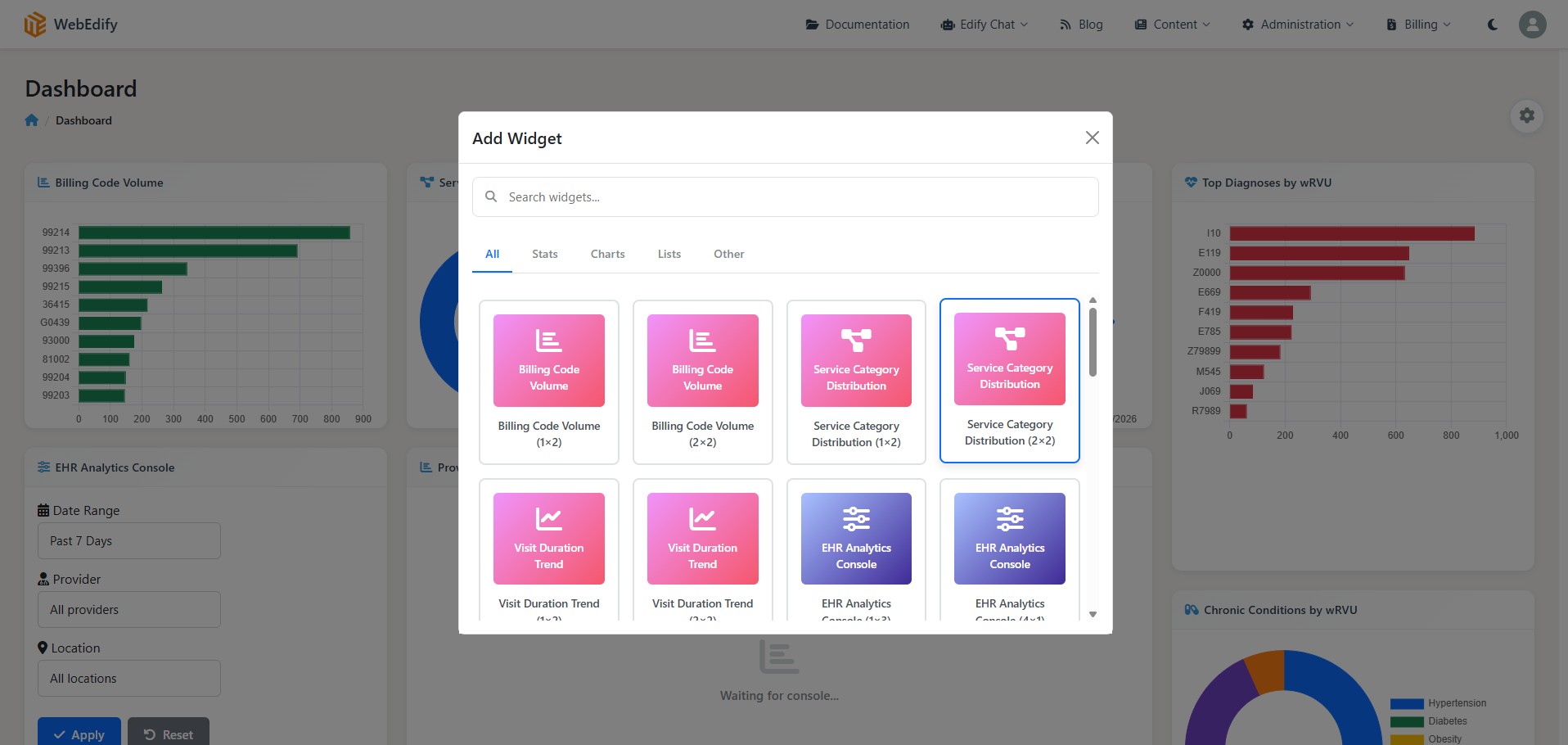
Every pattern above is assembled, not commissioned
The gallery, the category tabs, the size variants, drag-and-drop arrangement, and layouts
saved per person all come from the <@dashboard> tag. A developer declares
which widgets exist; the people using it decide what their own screen looks like.
That is why a healthcare dashboard and a board's giving report are the same engineering problem here. The domain changes, the mechanism does not.
See what else is includedSee the pattern that fits your world
Every one of these was built (or is being built) with the exact same declarative foundation you’re looking at right now.